First published in Verve, February 2018
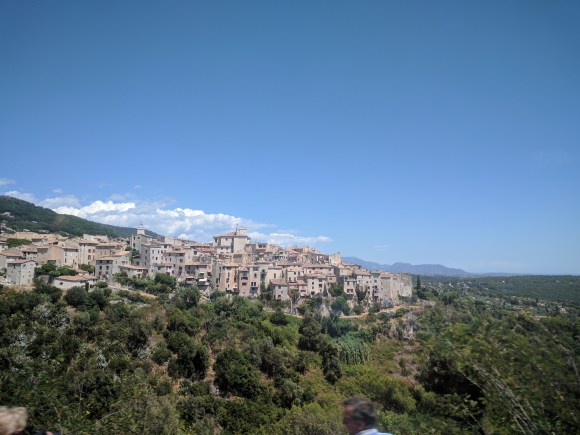
SAINT-PAUL DE VENCE, FRANCE
“It’s the most visited country in the world, is there really anything new to see here but tourists?” is the first thing I hear as we step off our luxury liner onto the docks of Saint-Raphael in southeastern France. There is, we soon discover, a locale so off-the-grid that it’s managed to maintain its original character even after so many centuries. Post a leisurely lunch near the Loup Canyon that flows through the Riviera, we head on an hour away to what I christen the haven on the hill, Saint-Paul de Vence.
COBBLESTONE CORNERS
As the bus stops a couple of kilometres from the village — the lanes being too small for vehicles — my aunt and I are in deep conversation about which spot we’d like to build our future houses on. The quaint town in Provence is lined with walls constructed in the middle of the 15th century, which have since remained untouched. We follow the hilly climb to the main road, Rue Grande, and the cobbled streets with its stone buildings, and tiny bylanes and stairways instantly transport me to medieval times!
At the end of it lies a stone terrace from where you’re treated to the most stirring view of the district. “I don’t ever want to leave!” I’ve mentally decided. Spot the Baou de Saint-Jeannet, a towering limestone bulk that adds a dash of brown to the majestic blue skyline.
GRAVESTONES AND GALLERIES
Just next to the terrace is a cemetery where one can find the remains of a familiar name in the art world — Marc Chagall. It’s the easiest grave to spot — coloured pebbles line the tomb, each with a message from an admirer. Spend a few moments strolling around — the quietude adds to the serenity of the moment. On my walk back, I decide to explore the boutiques and galleries that line the main road. Each one, in a bid to promote indigenous creations, hosts works by artists of the region — landscapes, still life, portraits, you have it all. A tiny store houses delicious jams and spreads — I end my walk with a taste of the chocolate spread, and a blueberry jam. While my family makes a detour for the L’Occitane En Provence store, I spend a few moments taking in the beauty of this haven. If there ever were a perfect place to just sit and watch the world go by, Saint-Paul de Vence would definitely be it.
CEUTA, SPANISH MOROCCO
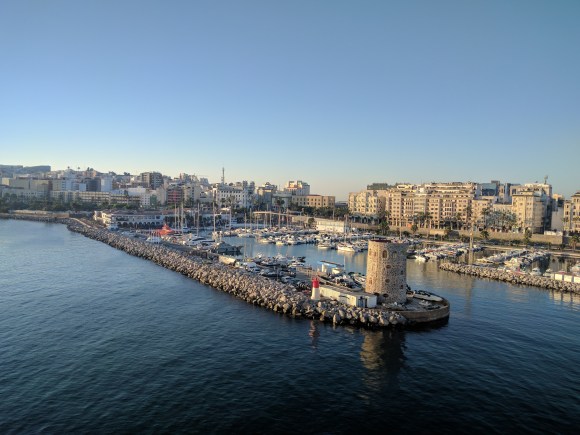
Our liner docks at the port a little after sunrise, and I peek out from the verandah of my cabin, in my excitement to set foot in Africa and cross one more continent off my bucket list. But there’s a catch — Ceuta may be on the African mainland, but is a territory of Spain, and one cannot cross over the barbed wire without a visa for Morocco. So, as we head out to explore the city, I’m still debating with my brother whether we’re technically in Africa or not!
AT THE CROSSROADS OF CULTURES
Being a part of Europe in Africa, Ceuta links two continents, and the people of four communities make up a major part of the population — Muslim, Jewish, Hindu and Christian. Our first stop for the day is Sidi Embarek mosque, just a short drive from the Royal Walls, fortifications that were built to protect Ceuta from attack. While entry into the 18th-century mosque is limited only to followers of the faith, others can walk around the adjoining cemetery that promises some great views of the sea. You’re instantly at peace in the environs, and the white-and-green facade of the mosque against the blues of the calming waters provide a great photo op. But it’s a visit to the church we see next, that soon becomes the highlight of my day.
The Ermita de San Antonio de Padua, or Hermitage of Saint Anthony of Padua, is a quaint little chapel situated on Monte Hacho, a small mountain that overlooks the city. A short walk up the winding slope from where the bus drops us, and we enter the yellow-and-white church. Behind the altar is a small statue of the saint the chapel is named after, the brown, gold and green marble around it lending it a grand touch. On the white-and-brown chequered floor, a few tiles are laid in a different colour in the shape of a cross. Legend has it that unmarried women who sit in the middle of this cross and trace it three times with their behind, will be granted a husband soon after! Ignoring my eye roll and foiling my attempts to escape from the chapel, my mother makes me sit down on this cross and wish for a life partner. (“You can return to Ceuta on your honeymoon to say thanks at this church,” she tells me later.)
On the other side of this 17th-century building lies the Monumento del Llano Amarillo, a 15-foot-tall sculpture that pays tribute to the defeated republican forces during the Spanish Civil War. Stand with your back to this monument, and if you’re here on a clear day, you’ll be lucky enough to catch a fantastic glimpse of the Rock of Gibraltar!
Of Panoramas And Beaches
Still reeling from the fact that I caught a view of the rock at sea, we head from Monte Hacho to a higher point of the city a short drive away, the Isabel II Viewpoint — and what greets us is nothing short of a treat. With the Mediterranean Sea on one side, the Atlantic Ocean on the other, and views of Ceuta, Morocco — and even Spain in the far distance — it’s a moment to save for posterity. Look closely, and you’ll even see the different blues of the two water bodies blending together at a point. It’s as though we’ve walked into a painting, I think to myself.
Several panoramic images and family selfies later, we head back to the main city centre, the Plaza de Africa. Churches, temples and mosques are all within short walks of each other here, and a few minutes away, at the Plaza de la Constitución, is a statue of Hercules, the mythical hero who is said to have separated the two continents of Europe and Africa with his superhuman might, creating the Strait of Gibraltar. This avenue is a delight for history and mythology aficionados, as several sculptures representing significant events and people through time — from Plato to Henry The Navigator — line the long walkway every few metres. My favourite discovery? A smiling statue of our very own Mahatma Gandhi — with his signature dhoti, round glasses and staff to boot — greeting me at the end of the road.
As our ship gets ready to set sail, we decide to make one last stop before we head back to our home on the sea. Making a slight detour, we head to the 270-metre-long beach, the Playa de la Ribera (Ceuta is home to several beaches right in the middle of the city centre) to dip our feet in the clear waters of the sea. And as I walk along the coastline one last time, I mentally add Ceuta to my list of favourite places — for there’s nowhere else in the world where you could be standing in Spanish territory on the African mainland, between the Mediterranean Sea and the Atlantic Ocean, and spotting the British Rock of Gibraltar!
JUNEAU, ALASKA
Docking in the capital city of USA’s 49th state one summer evening, we’re greeted by vibrant totem poles, verdant walkways and quaint houses. Whether it’s in water, air or on land, Juneau offers activities to satiate the appetite of every adventure fanatic. But what I’m most geared for is an experience that’s probably those once-in-a-lifetime things for an Indian leisure traveller — walking on a glacier that may or may not exist in a few years.
DASHING TO THE ICE
It’s our second day in Juneau, and all I’ve done the rainy night before is offer bribes to all the gods above for a clear, sunny day. And someone in the Alaskan heavens definitely loves me, because as we deboard the ship, I’m in immediate need of my sunglasses. We get onto the bus for the heliport, and the guide tells us that we’re extremely lucky, as they had to cancel the last two glacier rides due to extremely strong winds! A 30-minute ride through the green pastures, and we reach the base from where I will board a helicopter for the very first time, and I’m more nervous than all the other visitors there put together. A giant taxidermy bear greets us at the entrance to the heliport, and we spend time posing for photos with the furry creature. I listen in rapt attention as the guide teaches us how to use our life jackets — compulsory for all passengers — all the while hoping it’s never needed. Five of us — assigned seats according to our weight — walk towards the red-and-grey helicopter, the wind behind us adding a spring to our step. Seated next to the captain, I hold my mom’s hand tightly as we take off.
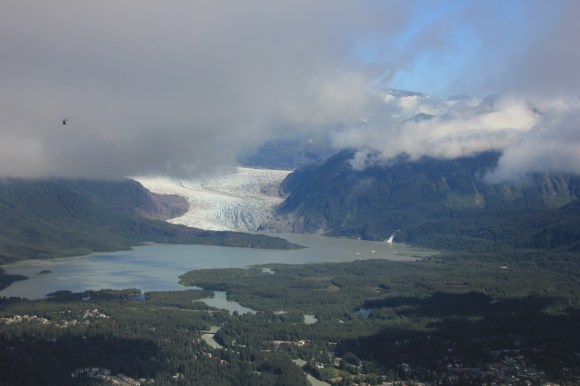
Two minutes later, we’re treated to aerial views of Alaska that get more breathtaking the higher we go. Butterflies play around in my tummy at each sharp turn our chopper takes, but wanting to capture every sight on my DSLR, I attempt to click as many photos as I can with my free hand (one still clutching onto my mother for dear life). Within 10 minutes of our ride, that passes over lush expanses of green, we spot a patch of pristine white — the Mendenhall Glacier. This is one of the 38 glaciers of the Juneau ice field, that stretches for a whopping 1,500 square miles, shaping the landscape as it moves.
A WALK IN THE CLOUDS
Alighting from the helicopter in our special ‘glacier shoes’, we take a minute to get used to their weight, having to put in extra effort to lift our feet with each step, stretching our arms out to balance ourselves. I feel like a one-year-old learning how to walk — I’m sure I look like it too! We’re told to tread carefully, not crossing the ropes kept at several points — heading into the ice caves or towards the edges could prove dangerous or even fatal. Encouraging us to feel the temperature of the water underneath the broken ice, the guide even tells us to break the frozen ground with a hard thump of the foot (my father throwing freezing cold water at me while I struggle to put my gloves back on is not appreciated in the least!). Want to beautify your skin too? Apply some mud from the glacier on your face and head home with a perfect glow.
Walking a little further, we come upon crystalline blue expanses of the ice that are so picturesque, it’s hard to look away. This colour is due to the absorption and reflection of light, we’re told, and the hue fades away when exposed to air. I’m in half a mind to pick off a piece of the glacier to take back as a keepsake, but knowing it will melt in seconds of our departure, decide otherwise — that I walked across a frozen land mass found in only a few pockets of the globe is memory enough to last a lifetime!
 Huzan Tata